
 Tiếng Việt
8 Criteria for Choosing a School Meal Catering Provider
Operating a school meal program is a large-scale daily operation, where catering providers are responsible for preparing and serving a significant volume of meals while maintaining strict control standards. Besides ensuring proper nutrition and food safety, service providers must also comply with school regulations and collaborate smoothly with administrative teams. Therefore, this article focuses on choosing a school meal catering provider with 8 criteria, helping parents and schools assess practical capabilities and potential for long-term collaboration.
Comprehensive Legal Documentation & Food Safety Certifications
Schools should prioritize catering providers with comprehensive legal documentation and food safety certifications, because this is a foundation for risk management, ensuring accountability in the operation, while also meeting supervisory oversight by the regulatory authority.
Essential documents commonly required in Vietnam include:
- Business Registration Certificate: Verify the legal status of the service provider. The registered business activity must include “food service,” “meal provision,” or “food processing and trading.” The documents must be valid and the information must match that of the contracting entity.
- Food Safety Eligibility Certificate: Issued by the Department of Health, the Food Safety and Hygiene Sub-department or an authorized agency to collective kitchens/pre-prepared meal processing facilities. The validity period is usually 3 years, and the address on the certificate must match the actual kitchen location.
- Food Safety Commitment or Food Quality Control Plan: This document describes how the provider manages food safety throughout the production process, including preparation procedures, kitchen cleaning, and the mandatory 24-hour food sample retention practice; must be formally signed by the company’s legal representative.
- Ingredient Traceability Documentation: The documentation shows where the materials come from and which batch they belong to, helping with traceability in case of problems and controlling input quality.
- Food Inspection or Quarantine Certificates: This applies to fresh food products subject to input control requirements, proving that the goods have undergone veterinary inspection/quarantine as per regulations before being used in processing.
One-Way Kitchen Workflow & Hygiene Control
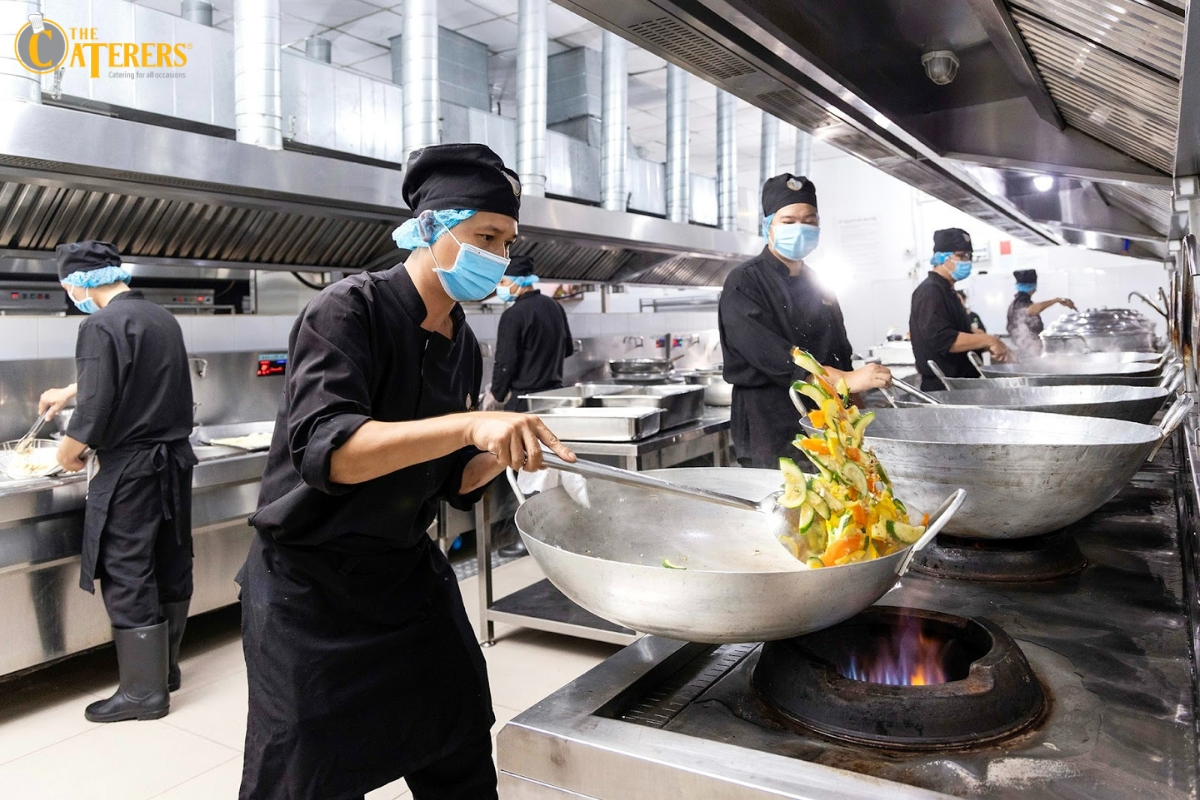
A professional institutional kitchen should follow one-way workflow principle, ensuring a clear operational flow from ingredient receiving, preparation, cooking, and portioning. This structured layout significantly reduces the risk of cross-contamination and allows better hygiene control during peak production hours. At the same time, catering providers should maintain clearly documented cleaning schedules for kitchen equipment and working areas, and monitoring checklists. Kitchen staff also need to train food safety practices and personal hygiene standards.
Capability to Develop School Meal Plans for Students
School nutrition requires an accurate understanding of student’s age group, activity level, and dietary habits. A professional catering provider should be capable of designing menus tailored to different age ranges, balanced semi-boarding meal plans, and adjusting menus according to seasonal availability and school’s operational conditions. Especially, avoiding the use of a single standardized menu is a must because of differences in taste preferences, allergy considerations, consumption levels, and regional food culture.
Transparent & Traceable Ingredient Sourcing
The quality of any catering service begins with the quality of its ingredients. Catering providers must establish strict supplier selection procedures, defined evaluation criteria, and batch-level input control mechanisms. Priority should always be given to fresh, safe ingredients with transparent origins and traceable supply chains. When the supply chain is properly managed, schools can operate with greater confidence in the consistency and safety of daily meals while minimizing risks associated with food sourcing.
Experience in School Catering Operations
Operational experience plays a critical role in delivering efficient school meal services. Catering partners with experience serving preschools or semi-boarding schools typically understand the usual rhythm of school environments from meal delivery schedules, food inspection procedures, and service flows. Experienced providers are also better prepared to handle unexpected situations during meal service, such as fluctuations in student attendance, feedback on menu preferences, or adjustments related to academic schedules and extracurricular activities.
Quality Control & Consistency of Meal Portions
School meals must maintain accurate portion sizes and consistent quality across all servings, particularly in institutions with large student populations. Catering providers should have internal quality control systems covering every stage of production, ingredient measurement, cooking temperature control, and product evaluation before meal distribution. A well-structured system reduces dependency on individual chefs, ensuring that quality is maintained through standardized procedures rather than subjective judgment.
Transparent Contracts & Clear Collaboration Responsibilities
A transparent contract form is a foundation for effective collaboration between schools and catering providers. Contract terms should define responsibilities for both parties, service standards, incident response procedures, and periodic reporting mechanisms.
Additionally, catering providers should establish communication channels that allow schools and parents to submit feedback, with defined response timelines to ensure concerns are addressed promptly. A commitment to continuous improvement helps build long-term trust and reduces tension if issues arise during service.
Long-term Partnership & Sustainable Development
Choosing a catering provider is a long-term operational partnership. A reliable catering partner will provide guidance on adjusting the menu periodically according to the seasons, nutritional needs, and actual feedback from students. As school enrollment grows, the provider should have sufficient resources to scale production, staff, and service processes while maintaining consistent meal quality. This long-term commitment instills a sense of stability and trust, ensuring that schools always have a professional and responsible partner supporting their meal programs.
Why Should Schools Choose a Professional School Catering Provider?
A professional catering provider significantly reduces risks related to food safety thanks to well-structured procedures and strict quality control systems. Consistent meal quality helps build trust with parents and enables schools to manage their boarding and meal programs more effectively. At high quality school canteens the perfect choice from the caterers, every meal is carefully prepared, and the school’s reputation is naturally strengthened as parents can feel the dedication reflected in even the smallest details.
The Caterers – A Core Standards School Catering Partner
With more than 20 years of experience and a dedicated team of over 700 staff, The Caterers delivers high-standard catering services designed for environments that demand reliability and consistency. The company focuses on food safety, scientific school meal portions, and the professional operation process, placing the peace of mind of schools and parents at the center of service philosophy.
The Caterers stands out through its supply chain integrity with a process supported by Farm-to-School and Global/GAP standards. Advanced Menu Engineering capabilities, combined with an experienced R&D team specializing in school nutrition, ensure that menus are carefully curated to balance taste, nutritional value, while still enjoyable to have when lunch breaks come. At the same time, food safety management systems such as HACCP and ISO 22000 provide comprehensive risk control and safeguard the reputation of partner schools.
To better understand how The Caterers balance nutrition, flavor, and operational feasibility in real school environments, you can check through sample menu 1 for lunch and sample menu 2 for full-day meal planning.
Contact The Caterers to offer professional consultation on menu design, catering processes, and efficient School Canteen.


