For school meal programs, food safety and hygiene is not only a mandatory standard but also The Caterers' highest commitment to protecting the health, physical development, and holistic thinking of future generations.
1. International Standards System
The Caterers operates its entire food processing pipeline based on the most stringent quality management certifications:
- HACCP (Hazard Analysis and Critical Control Points): A system for hazard analysis and critical control points implemented throughout kitchen operations.
- ISO 22000: The international standard for food safety management systems, ensuring safety from farm to table.
- Food Safety and Hygiene Certification: Granted by local competent authorities to verify that the kitchen meets all safety and hygiene requirements.
2. Closed-Loop "Five-Step" Quality Control Process
Step 1: Stringent Selection of Input Ingredients
- 100% of ingredients are sourced from leading reputable suppliers and farms, fully backed by invoices and documentation proving their origin (such as VietGAP and GlobalGAP).
- Fresh ingredients like meat, fish, and vegetables are delivered daily and undergo rigorous sensory evaluations as well as temperature checks upon arrival at the kitchen warehouse.
Step 2: Preparation and Cooking Follow the "One-Way" Kitchen Principle
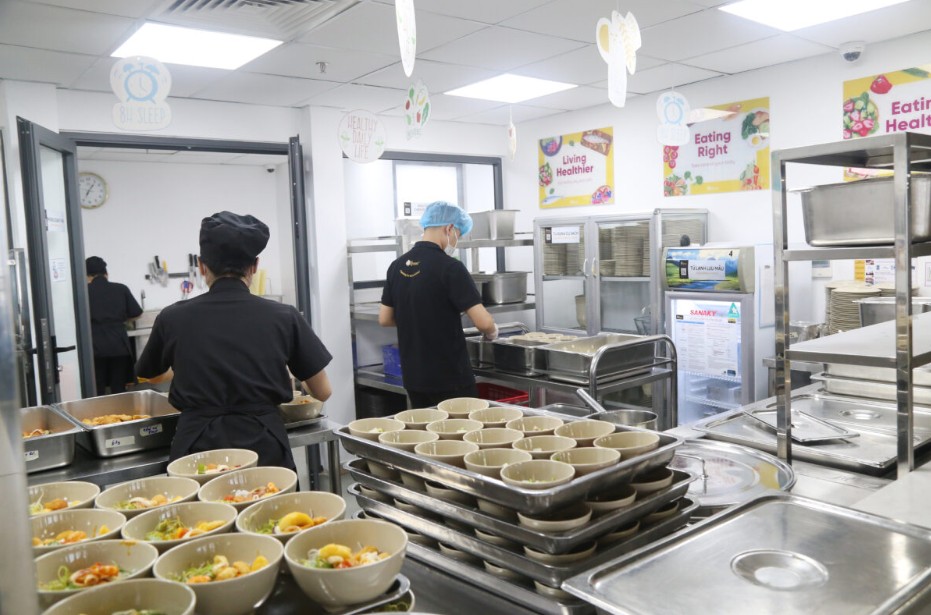
- The kitchen layout is strictly designed according to a one-way workflow: Receiving Area $\rightarrow$ Preparation Area $\rightarrow$ Cooking Area $\rightarrow$ Portioning Area $\rightarrow$ Serving Area.
- This structural design completely eliminates the risk of cross-contamination between raw and cooked food, as well as between unprocessed ingredients and finished products.
Step 3: Professional and Regularly Trained Staff
- All chefs and service staff at school kitchens must undergo periodic health check-ups and hold food safety knowledge training certificates.
- Employees are strictly required to wear full personal protective equipment (PPE)—including kitchen uniforms, hairnets, face masks, and specialized gloves—throughout their entire shift.
Step 4: Temperature Control and 24-Hour Food Sample Retention
- Temperature Assurance: Once cooked, food is continuously kept warm at a standard temperature (above 60°C) until it is served directly to students, minimizing bacterial growth.
- Strict Sample Retention: Samples of all dishes are retained for 24 hours in sterilized, sealed glass jars with clear date and time labels, under the supervision of school representatives.
Step 5: Equipment Sterilization and Kitchen Environment Sanitation
- Cooking equipment, utensils, and students' food trays are dried and sterilized at high temperatures using commercial dishwashing systems.
- The kitchen space and cafeteria area undergo deep cleaning at the end of every day using safe disinfectant solutions approved by the Ministry of Health.
3. Partnering with Schools and Parents
- Transparency of Information: The Caterers is always ready to open its doors to the Board of Directors and the Parent Representative Committee for unannounced visits to monitor the ingredient receiving and food preparation processes at the kitchen.
- Nutritional Education: Beyond providing safe meals, we collaborate to organize sharing sessions about culinary culture, healthy eating habits, and personal hygiene for students.